
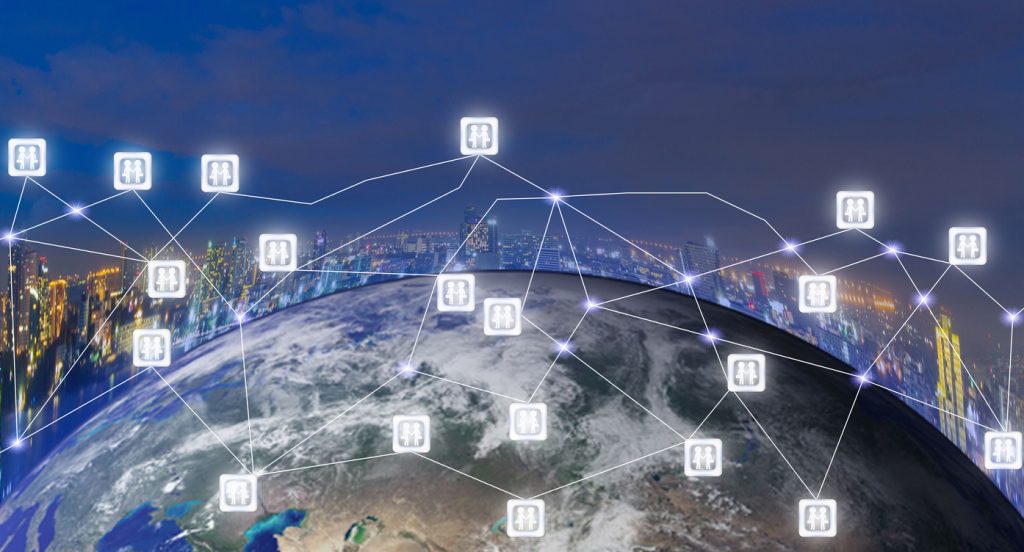
Hann-Ju Ho, senior economist for Lloyds Bank Commercial Banking, looks back at the history of globalisation to understand why it was on the agenda in Davos.
Luminaries from
across the political and business world gathered last week for the World
Economic Forum (WEF) Annual Meeting in Davos, Switzerland,
Although concerns
about near-term global economic growth and trade tensions dominated conversations,
the official theme of this year’s forum was ‘Globalisation 4.0: Shaping a
Global Architecture in the Age of the Fourth Industrial Revolution’.
But what does
this mean and why is it expected to be important for the future?
To understand
what Globalisation 4.0 means, it’s useful to look back on the previous waves and
consider how they have shaped the world we live in.
Technology driving trade
Globalisation 1.0
refers to the rapid growth in world trade, mainly during the nineteenth century.
It was driven by innovations
in transport and communications, including the railways, steamships and the electric
telegraph.
The subsequent reduction
in the cost of global transport enabled the separation of production and
consumption across international borders, making previously exotic products
like tea, sugar and cotton readily available and affordable in markets like the
UK for the first time.
Globalisation surged
again after the Second World War – dubbed Globalisation 2.0.
Driven by greater
international cooperation, the post-war period saw less protectionism and a rapid
growth in world trade, at least in western economies.
Enabling offshoring
The third wave of
globalisation is thought to have started around 1990.
Further advances
in technology, including the spread of the internet, made it easier for
different stages of production to be based in various locations across the
globe, leading to the emergence of modern supply chains.
This enabled
firms to further cut the cost of producing products and delivering services by
moving their operations to cheaper locations, known as offshoring.
However, it’s
also likely have contributed towards rising disenchantment, particularly where
people in more advanced economies feel that they have not reaped the rewards.
The next wave,
dubbed Globalisation 4.0, is set to be driven by the Fourth Industrial
Revolution, which is happening right now.
The development
of advanced technologies like artificial intelligence, big data,
nanotechnology, the internet of things, 3D printing and autonomous vehicles all
have the potential to significantly impact global productivity.
Opportunity and inequality
Unlike the previous waves, which have mainly affected goods-producing sectors, Globalisation 4.0 is predicted to have a much greater impact on services.
Unlike the previous waves, which have mainly affected goods-producing sectors, Globalisation 4.0 is predicted to have a much greater impact on services.
And we live in an
increasingly connected world, so the speed of its adoption may also be faster
than in previous waves.
Attendees at
Davos not only discussed the opportunities that Globalisation 4.0 is expected
to create, such as increased productivity, but also considered the growing
evidence of a backlash against globalisation.
The WEF could be regarded
as the ultimate representation of globalisation, so it is no surprise that meeting
the challenges this latest wave of economic change brings for individuals and
society were high up on the delegates’ agenda.