
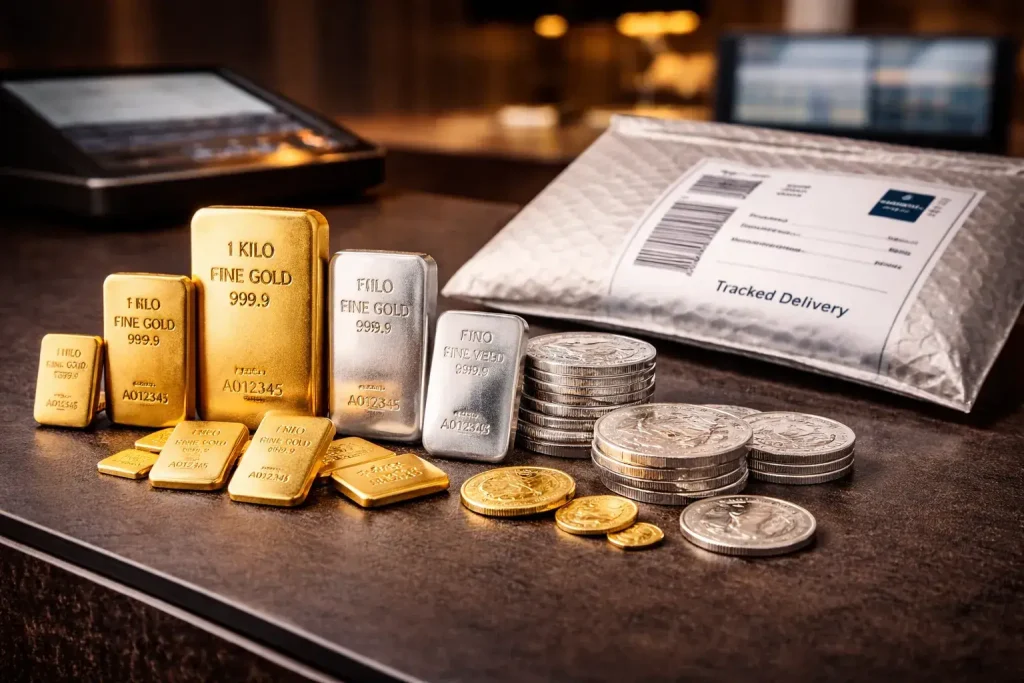
Diversification is one of the longest-standing ideas in retirement planning. It means spreading savings across assets that don’t all move together, so a bad year for one is less likely to sink the plan. Gold and silver tend to come up in that conversation because they have historically moved on a different schedule from stocks and bonds.
How gold has behaved when stocks fall
The World Gold Council notes that gold’s “negative correlation to equities and other risk assets increases as these assets sell off.” For example, during the 2008 financial crisis, equities, hedge funds, real estate and most commodities fell, while gold rose 21% in dollar terms from December 2007 to February 2009. Gold’s returns also stayed positive through the equity pullbacks of 2022 and 2025.
Gold has at times moved with stocks in rising markets, but its record as a diversifier comes from how it behaved in the bad stretches.
A store of value
Historically, gold and silver have been used by savers as a store of value and a response to a weaker dollar. Over a span of months, metal prices can swing sharply, so many buyers treat it as a holding measured in years.
A tangible asset
A stock depends on a company and a bond on an issuer that has to pay. The value of precious metals doesn’t depend on any single company or issuer, and that can appeal to savers who want part of their money outside the financial system. Gold also trades in a deep global market, so it can usually be sold when other holdings are harder to move.
Silver’s industrial side
Silver differs from gold because of its use in electronics and solar panel manufacturing. Industrial users took 657.4 million ounces of the 1,130.6 million ounces of silver demanded in 2025, about 58% of the total, according to the Silver Institute’s World Silver Survey 2026. Solar panels alone accounted for 186.6 million ounces.
Silver’s price can be volatile. It started 2025 below $29 an ounce, peaked at $84 in December and hit a record above $121 on Jan. 29, 2026, according to the Silver Institute. It fell back to the high $60s by late March and traded around $53 in early November.
How much do savers hold?
In its 2026 report on gold as a long-term holding, the World Gold Council tested hypothetical mixes with 2.5%, 5%, 7.5% and 10% in gold and found each “would have achieved higher risk-adjusted returns and lower drawdowns.” It also found that the riskier the rest of the mix, the larger the gold share needed to offset that risk. An older Council paper, from 2011, put long-term optimal allocations between 2% and 10% for traditional mixes of stocks, bonds and commodities.
These are backtests and published ranges, not a recommendation for any individual. The right figure depends on the whole mix and the saver’s own goals.
The costs
- No income. Gold and silver pay no dividend or coupon, so the return rides on price.
- Premiums and storage. Every purchase includes a markup over spot, typically a few percent on gold bars and more on silver coins, and metal has to be stored and insured.
- Tax treatment. When held outside a retirement account, gains on coins and bullion may be taxed as collectibles, at a maximum long-term rate of 28%. Metal held in an IRA follows IRA distribution rules instead.
Two ways to hold metal for retirement
Savers can buy metal directly, in their own name, with control over where it’s kept and outside retirement-account rules. Or they can open a self-directed precious metals IRA. That route can offer tax-deferred or Roth treatment, subject to IRS rules. Those rules require an approved custodian and storage with a third-party depository, so the metal can’t be kept at home. Some savers work with an established precious metals company such as Lear Capital, founded in 1997, while others buy and store on their own.
Common questions
Why add precious metals to retirement savings? Retirement savers have often added precious metals for diversification. Gold has historically become more negatively correlated with stocks during sell-offs.
How much do people put in gold? World Gold Council research has tested allocations between 2.5% and 10%, but the right figure depends on the individual.
Has gold held up in every downturn? No. It has often held or gained value during equity sell-offs, but it has also fallen alongside stocks at times, and over short periods it can be volatile.
Gold or silver? Gold has the longer record as a diversifier. Silver carries more industrial demand, and its price has swung harder, climbing from below $29 at the start of 2025 to a record above $121 in January 2026 before falling back. Some savers hold both.
This article is for informational purposes only and does not constitute investment, tax, or legal advice. Consult a qualified financial or tax professional before making decisions about your retirement savings.