
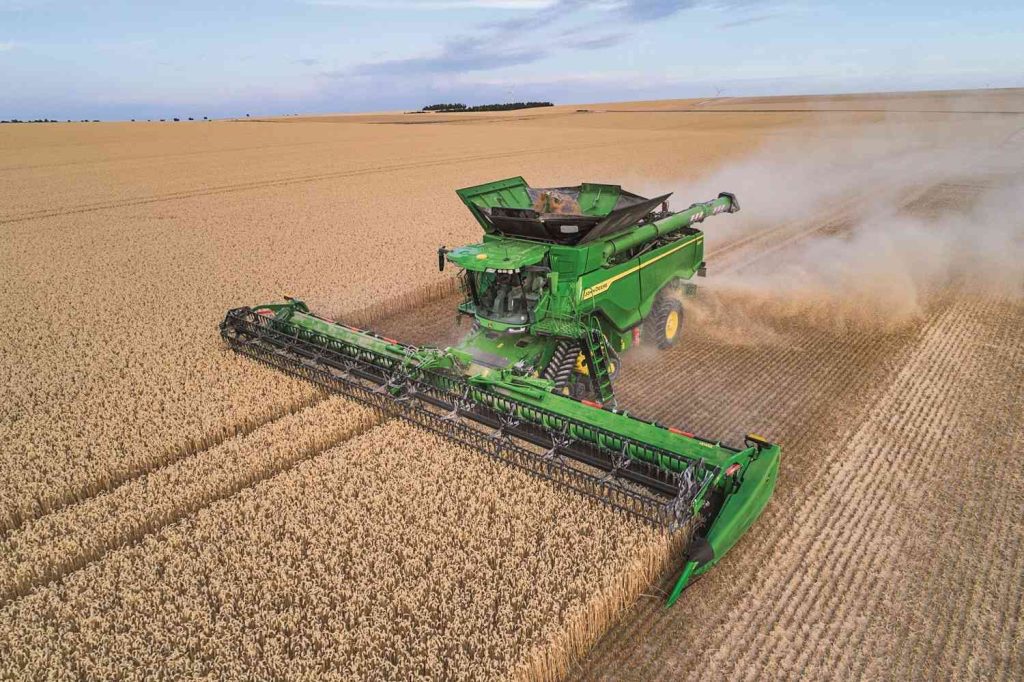
Deere & Company (NYSE: DE) reported a 3% decline in annual net income to $4.86 billion on 25 November 2026, as a $325 million increase in income tax expense more than offset growth in pre-tax earnings. Worldwide net sales and revenues rose by 4% to $47.7 billion, supported by stronger sales of smaller agricultural machinery and construction equipment.
The US machinery manufacturer expects demand for large agricultural equipment in the US and Canada to recover in 2027, forecasting annual net income of between $4.5 billion and $5.25 billion. The midpoint of that range is just $15 million above its 2026 profit, with the forecast including an estimated one-time, non-cash pension settlement charge of $250 million to $400 million.
Higher Tax Costs Offset Growth in Deere’s Pre-Tax Earnings
Deere’s fourth-quarter and full-year financial results show that worldwide net sales and revenues increased by 4% to $47.704 billion in the financial year ended 1 November 2026. Equipment net sales rose by 6% to $41.292 billion, while annual diluted earnings per share declined from $18.50 to $17.95.
Consolidated pre-tax income increased from $6.257 billion to $6.397 billion, but the company’s income tax provision rose by $325 million to $1.584 billion, lifting its effective tax rate from approximately 20.1% to 24.8%. The previous financial year benefited from favourable discrete tax items, including $110 million associated with foreign net operating losses and $53 million relating to an adjustment to a foreign subsidiary’s uncertain tax position.
Fourth-quarter sales and revenues declined by 2% to $12.115 billion, while net income fell from $1.065 billion to $1.051 billion. Full-year profit nevertheless remained within the company’s previously announced guidance of $4.75 billion to $5 billion.
Construction and Smaller Farm Equipment Offset Large Machinery Weakness
Deere’s Production & Precision Agriculture division recorded a 9% decline in annual net sales to $15.682 billion, while operating profit fell by 33% to $1.778 billion, a reduction of $893 million compared with the previous financial year. Small Agriculture & Turf recorded a 15% increase in annual net sales to $11.739 billion, with operating profit rising by 47% to $1.771 billion.
Construction & Forestry sales increased by 22% to $13.871 billion, while operating profit rose by 43% to $1.473 billion. Together, the two smaller equipment divisions generated an additional $1.009 billion in operating profit, more than offsetting the decline in Production & Precision Agriculture.
Including Financial Services, Deere’s total segment operating profit increased by 2% to $6.151 billion. The company also recorded $383 million in tariff recoveries during the financial year, while the previous year’s results included litigation and impairment charges that affect the comparison between the two reporting periods.
North America Leads Deere’s Agricultural Equipment Outlook
Deere expects industry sales volumes for large agricultural equipment in the US and Canada to increase by 5–15% during fiscal 2027. The outlook for Europe remains weaker, with agricultural equipment volumes expected to remain flat or decline by up to 5%, while South American tractor and combine sales are forecast to remain flat or increase by up to 5%.
For its own Production & Precision Agriculture division, Deere forecasts net sales growth of 5–15% and an operating margin of between 12.5% and 14.5%, compared with 11.3% in fiscal 2026. By contrast, the company expects its Small Agriculture & Turf operating margin to decline from 15.1% to between 12.5% and 13.5%. Construction & Forestry has an operating margin forecast of 9.5–11.5%, compared with 10.6% in the previous financial year.
Pension Settlement Charge Weighs on 2027 Earnings Guidance
Deere’s 2027 earnings forecast includes an estimated one-time, non-cash pension settlement charge of between $250 million and $400 million. The charge relates to a voluntary lump-sum payment option for certain salaried retirees in the United States, with Deere’s earnings release providing no separate estimate of its after-tax impact.
The lower end of Deere’s net income guidance would represent a 7.4% decline in annual profit, while the upper end would represent an increase of approximately 8%. At the midpoint, earnings would rise by just 0.3%. The anticipated pension charge and lower margins in smaller agricultural equipment could therefore limit the extent to which recovering demand for larger machinery translates into higher group earnings.
Deere Cuts Share Buybacks as Operating Cash Flow Falls
Deere’s consolidated operating cash flow fell by almost 20% to $5.978 billion in fiscal 2026, down from $7.459 billion a year earlier. The company reduced spending on share buybacks from $1.138 billion to $796 million, while cash dividend payments increased from $1.720 billion to $1.753 billion. Total cash returned to shareholders fell by $309 million to approximately $2.55 billion.
For fiscal 2027, Deere expects its equipment operations to generate between $4.5 billion and $5.5 billion in operating cash flow, with capital expenditure of approximately $1.5 billion. The midpoint of the cash flow forecast is just over 1% higher than the $4.944 billion generated by its equipment operations in 2026.