

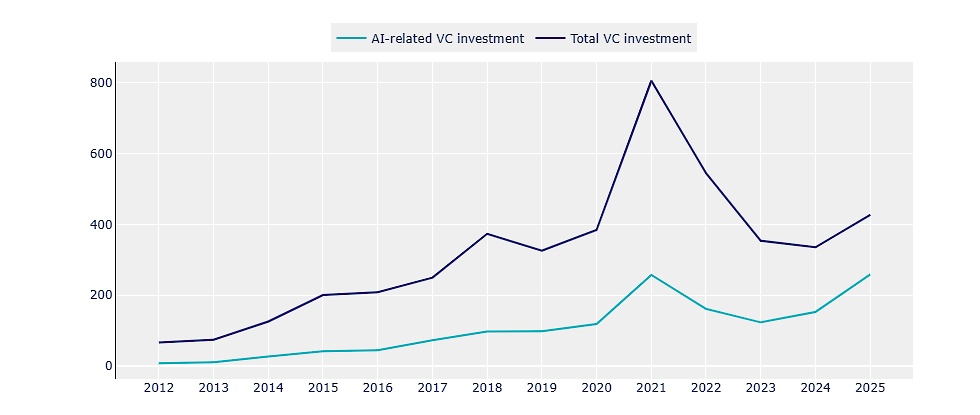
Investors put over $97 billion into AI companies globally in 2025, roughly 40% of all venture funding. The excitement is understandable. AI startups are building products that can underwrite loans, detect fraud, automate customer support, and generate code. The demos are impressive. The pitch decks are ambitious. The revenue charts, in many cases, are genuinely compelling.
And yet, roughly a third of deals already collapse at the final hurdle over preventable gaps, according to reporting by Startups Magazine. Fewer than 15% of investing firms had a formal framework for assessing how AI companies sourced and handled data. When Anthropic settled a training data dispute for $1.5 billion, it gave every investor a concrete price tag for what “we’ll sort out the IP later” actually costs.
Here is the uncomfortable truth: an AI startup’s demo, customer traction, and performance claims do not establish that its technology is reliable, defensible, secure, or commercially scalable. A model that performs brilliantly in a controlled demonstration can fail unpredictably in production. A product that looks proprietary can turn out to be a thin interface over a third-party API. Revenue growth that appears sustainable can depend on inference economics that deteriorate as usage increases.
Investors need verifiable technical evidence before committing capital. A structured technical due diligence for AI Companies process can help separate genuine technological advantage from effective packaging. This checklist covers eight assessment areas, each following the same structure: what to request from the startup, what a good answer looks like, and red flags that deserve further investigation.
The eight areas at a glance:
- Architecture and technology stack
- Model performance and evaluation
- Data provenance and IP rights
- Technical defensibility
- Unit economics and inference costs
- Security, privacy, and AI agent permissions
- Production readiness and scalability
- Engineering team and technical debt
1. Architecture and Technology Stack
Core question: Is the AI product built on an architecture that can be maintained, extended, and operated reliably?
What investors should request: System architecture and infrastructure diagrams. Technology stack and deployment documentation. Third-party model, API, and platform dependencies. Model versioning and deployment practices. Development, testing, and production environments.
What a good answer looks like: Documented and understandable architecture with clearly identified model versions and dependencies. Repeatable deployment processes with appropriate staging and testing environments. No critical reliance on undocumented manual processes.
Red flags: Undocumented architecture or model dependencies. Critical prompts and configurations known only to one engineer. Manual deployment processes with no separation between testing and production. Excessive dependence on a single third-party provider without alternatives or contingency plans.
2. Model Performance, Evaluation, and Reproducibility
Core question: Does the AI product perform consistently under independent testing and real-world conditions?
What investors should request: Evaluation datasets and testing methodology. Benchmark reports and model performance metrics. Evaluation harness and version history. Production performance logs. Evidence of testing on representative or independent datasets.
What a good answer looks like: Versioned evaluation datasets with reproducible test results. Clearly defined performance metrics with documented changes in model performance over time. Evidence that benchmark results reflect real customer workloads, not curated demonstrations.
Red flags: Performance claims supported only by internal demonstrations. Benchmarks based entirely on company-selected test data. No independent validation or blind holdout testing. Data leakage between training and evaluation datasets. No record of model regressions or performance changes over time.
Consider a practical example. An AI startup demonstrates a document processing product that achieves 97% accuracy during a live investor demo. Impressive. During technical diligence, the evaluation team discovers that the test dataset was hand-selected by the company, the model has never been tested on documents outside its training distribution, and production logs show accuracy dropping to 71% on a customer’s real-world document set. The demo was real. The 97% figure was real. But it did not represent the product’s actual performance in the conditions that matter.
3. Data Provenance, Ownership, and Intellectual Property Rights
Core question: Does the startup have the legal rights to use the data and technology that power its AI product?
What investors should request: Training data and fine-tuning data sources. Data licences, agreements, and ownership documentation. Retrieval data sources and customer data policies. Model ownership and third-party licensing arrangements. Data retention and deletion procedures.
What a good answer looks like: Documented data provenance with clear commercial usage rights. Appropriate customer consent and contractual permissions. Defined ownership of proprietary datasets and model assets. Deletion processes that cover source data and relevant derived representations, including embeddings and cached data.
Red flags: Unclear ownership of training datasets. Web-scraped data without a documented legal basis. Customer data used for model training without appropriate permission. Unclear rights to fine-tuned or third-party models. Deletion procedures that do not account for embeddings or vector stores.
This area has become a deal breaker more frequently than any other. VCs report walking away from startups whose founders cannot prove where their training data came from and that they obtained it lawfully. The EU AI Act’s training data transparency obligations for general purpose models are phasing in through 2026, adding regulatory urgency to what was already an investment risk.
4. Technical Defensibility and Competitive Advantage
Core question: What prevents a competitor from replicating the startup’s AI capabilities?
What investors should request: Documentation of proprietary models, datasets, and workflows. Evidence of product differentiation. Customer integration and workflow dependencies. Research and development roadmap. Evidence of domain-specific capabilities or accumulated learning.
What a good answer looks like: The startup can demonstrate a credible advantage through proprietary data and data acquisition capabilities, specialised models or measurable performance advantages, deep workflow integrations and customer adoption, distribution advantages and established customer relationships, or domain-specific expertise and compliance infrastructure.
Red flags: A thin interface over a publicly available model. No proprietary data or meaningful workflow advantage. Product differentiation based mainly on prompt engineering. No evidence that customers would face meaningful switching costs. Competitive advantage based on features that competitors can reproduce quickly using commercially available APIs.
Investor perspective: Weak technical defensibility does not automatically make an AI startup a poor investment. But it should change the valuation basis. A company that has built a genuinely difficult-to-replicate AI capability deserves a different multiple than one that has assembled commercially available components into a polished product. The diligence should tell you which one you are looking at.
5. AI Unit Economics and Inference Costs
Core question: Can the startup deliver its AI product profitably as customer usage increases?
This is where many AI investments reveal their most consequential surprise. IDC forecasts that Global 1,000 companies will underestimate their AI infrastructure costs by 30% through 2027. For startups operating at the frontier of model capabilities, the gap can be even wider.
Gartner estimates that AI infrastructure will add approximately $401 billion in new enterprise spending in 2026. Meanwhile, a Cast AI report found that average enterprise GPU utilisation sits at roughly 5%, meaning that approximately 95 cents of every silicon dollar goes unused. These macro figures matter because they reflect the same economic dynamics that affect individual AI startups: inference is expensive, utilisation is low, and the cost of delivering AI-powered outcomes is frequently higher than financial projections suggest.
What investors should request: Inference cost per request, session, or completed task. Input and output token consumption. GPU and cloud infrastructure expenses. Retrieval, storage, and external API costs. Human review and operational expenses. Gross margins across different customer and usage segments.
What a good answer looks like: Clear cost breakdowns by workflow or customer. Documented inference and infrastructure expenses. Understanding of cost per successful task (not just cost per API call). Gross margin calculations that account for all attributable delivery costs. Scenarios showing how costs change as usage increases tenfold.
Red flags: No separate tracking of inference expenses. Gross margins that exclude material delivery costs. Financial projections based on cost optimisations that have not been implemented. Excessive dependence on one model provider’s pricing. Human review requirements hidden outside reported delivery costs.
Investor perspective: Revenue growth alone does not demonstrate sustainable AI economics. Investors should understand whether the cost of delivering successful outcomes improves as the business scales, or whether it stays flat or gets worse.
6. Security, Privacy, and AI Agent Permissions
Core question: Can the startup protect sensitive data and prevent AI systems from taking unauthorized actions?
The 2026 OWASP Top 10 for GenAI and LLM Applications placed prompt injection as the number one vulnerability for the third consecutive year, with excessive agency climbing from eighth to third. These are not theoretical risks. A VentureBeat Q1 2026 tracker found that 88% of enterprises reported AI agent security incidents in the past year, and security and compliance as a top priority rose from 41.5% to 48.7% among AI infrastructure buyers.
What investors should request: Security architecture and access control policies. API key and secrets management practices. Data privacy and retention policies. AI agent permissions and tool access documentation. Prompt injection and adversarial testing reports. Incident response and vulnerability management records.
What a good answer looks like: Least-privilege access controls for both humans and AI agents. Secure credential storage and rotation. Defined data isolation and access policies. Testing against prompt injection and unsafe tool execution. Documented incident response procedures.
Red flags: Excessive permissions granted to AI agents with no behavioural boundaries. API keys or credentials exposed in source code. No separation between customer data environments. No testing for prompt injection or tool misuse. Unclear policies for handling sensitive information within AI workflows.
7. Production Readiness, Reliability, and Scalability
Core question: Can the AI product handle real-world usage without unacceptable performance degradation or infrastructure costs?
What investors should request: Uptime and incident history. Production monitoring dashboards. Load and stress testing results. Model serving architecture and capacity plans. Recovery procedures and disaster recovery documentation. Latency, throughput, and reliability metrics.
What a good answer looks like: Production monitoring and observability covering both application and model performance. Documented incidents and post-mortems that show the team learns from failures. Testing under realistic workloads with defined recovery objectives. Evidence that the platform can handle increased usage without linear cost increases.
Red flags: No meaningful production monitoring beyond basic uptime checks. No documented incident history (which usually means incidents are not being tracked, not that they are not happening). Load testing limited to the application layer without testing model inference under load. No model inference capacity planning. No tested recovery or rollback procedures for model deployments.
8. Engineering Team Depth and Technical Debt
Core question: Does the startup have the engineering capability to maintain and improve its AI technology?
What investors should request: Engineering organisation chart and responsibilities. Code review and repository history. Dependency and vulnerability audit. Technical debt backlog. Documentation and knowledge transfer procedures. On-call and incident ownership arrangements.
What a good answer looks like: Multiple engineers understand critical production systems. Documented architecture and operational procedures. Prioritised technical debt remediation with realistic timelines. Regular code reviews and dependency updates. Clear ownership of AI-specific production incidents, not just application incidents.
Red flags: Critical systems understood by only one engineer. Significant dependence on former employees or founders for institutional knowledge. Unmaintained dependencies with known vulnerabilities. No documented technical debt backlog. No clear ownership of production AI failures (model regressions, hallucination incidents, inference degradation).
What Investors Should Do With Technical Due Diligence Findings
Technical findings should not simply be recorded in a report. They should inform investment decisions and deal terms.
Category 1: Deal blockers
Issues requiring resolution or a clear contractual solution before closing. Examples include serious IP ownership disputes, material data rights issues, critical security vulnerabilities, or technology that cannot legally be transferred. These are the findings that kill deals or require fundamental restructuring before proceeding.
Category 2: Deal risks
Issues that may affect valuation, deal structure, or investment conditions. Examples include underestimated infrastructure costs, weak model defensibility, significant technical debt, and unproven scalability. Potential responses include price adjustments, escrow, warranties, indemnities, or milestone-based payments, subject to legal and commercial advice.
Category 3: Post-investment improvements
Issues that can be addressed through a planned technical remediation programme. Examples include improving observability, optimising inference costs, strengthening documentation, and reducing deployment complexity. These are the items that belong in the first-year operating plan, not the deal negotiation.
For investors evaluating AI businesses, a structured assessment of architecture, model performance, data ownership, security, and scalability can help reveal risks that may not appear in financial projections or product demonstrations. Specialist technical due diligence for AI Companies can help investors connect engineering findings with valuation assumptions, transaction risks, and post-investment priorities.
A good technical due diligence review is not about finding a startup with no technical problems. It is about identifying material risks early enough to understand their financial impact and make informed investment decisions.
Technical Evidence Should Support Every AI Investment Thesis
The eight areas covered here form a progression from technology foundations to investment implications: architecture and technology stack, model performance and evaluation, data provenance and IP rights, technical defensibility, unit economics, security and privacy, production readiness, and engineering team depth.
Each area can reveal risks that are invisible in a pitch deck, a product demo, or a set of financial projections. And each area connects directly to questions that investors care about: will this technology scale, is it defensible, can it be delivered profitably, and is the team capable of executing the roadmap?
AI investment decisions require evidence beyond product demonstrations and management projections. Independent technical assessment, conducted before committing capital, is the difference between investing in a genuinely capable AI business and paying an AI premium for technology that does not justify it.
Dextra Labs works with investors, VC and PE firms, and M&A teams to assess AI technology, identify technical risks, and support better-informed investment decisions across Singapore, the USA, the UAE, and India.
Frequently Asked Questions:
What do investors check during technical due diligence for AI startups?
Investors typically examine eight areas: architecture and technology stack, model performance and reproducibility, data provenance and IP ownership, technical defensibility, AI unit economics and inference costs, security and AI governance, production readiness and scalability, and engineering team depth. Each area is assessed for its impact on the investment thesis, valuation, and post-investment requirements.
How long does technical due diligence take for an AI startup?
A focused technical due diligence engagement for an AI startup typically takes two to four weeks, depending on the complexity of the AI architecture, the number of models in production, documentation availability, and management access. Time-sensitive transactions can be assessed in shorter timeframes, though critical areas like data provenance and model evaluation should not be compressed beyond the point where findings remain reliable.
What are the biggest technical risks in AI startup investments?
The most consequential risks include unclear data ownership and IP rights (which can create legal exposure), unsustainable inference economics (where costs grow faster than revenue), weak model defensibility (where competitors can replicate the product using commercially available APIs), key person dependencies (where critical AI systems are understood by only one engineer), and inadequate security controls (particularly around AI agent permissions and prompt injection vulnerabilities).
How does technical due diligence affect AI startup valuation?
Technical findings can influence valuation by changing assumptions about post-investment costs (infrastructure, remediation, hiring), competitive defensibility (proprietary technology versus assembled components), scalability (whether the platform can support projected growth), and risk (security, IP, and regulatory exposure). Weak technical defensibility may shift the valuation basis from a technology premium to a customer and revenue multiple.
What should a technical due diligence report for an AI startup include?
A useful report includes an executive summary, AI architecture overview, model performance assessment, data provenance and IP analysis, technical defensibility evaluation, inference cost and unit economics analysis, security and governance findings, production readiness assessment, engineering team evaluation, risk prioritisation by severity and financial impact, remediation recommendations, and estimated investment requirements.